


.webp)
Extreme Pressure (EP), Anti-Wear (AW), Anti-Friction (AF): How WS2, MoS2, and hBN Work
When a lubricant formulator specifies an additive as "EP/AW/AF," they are describing three distinct but overlapping failure mechanisms that a solid lubricant additive must protect against. Understanding the difference between EP, AW, and AF performance — and why solid lubricants like WS2, MoS2, and hBN excel across all three — helps formulators select the right additive at the right concentration for their specific application. This article provides a precise technical explanation aimed at lubricant formulators, tribologists, and R&D engineers.
Tribology: The Science Behind Lubrication
Tribology is the study of friction, wear, and lubrication between surfaces in contact. In any lubricated system, three lubrication regimes exist depending on load, speed, and viscosity:
- Hydrodynamic lubrication: Full fluid film separates surfaces — no metal-to-metal contact. Standard base oil viscosity provides all the protection needed.
- Mixed lubrication: Partial fluid film — some asperity contact occurs. AW additives are critical here.
- Boundary lubrication: No fluid film — direct metal-to-metal contact under extreme load. EP additives become the only protection available.
Most real-world industrial equipment operates in mixed or boundary lubrication during startup, overload, shock loading, or low-speed high-load conditions. This is where EP and AW additives provide value.
Extreme Pressure (EP) Additives
EP additives protect metal surfaces when contact loads are so high that the lubricant film is completely displaced and direct metal-to-metal contact would cause adhesive wear, galling, or welding. Standard viscosity and AW additives are insufficient — the interface needs a load-bearing sacrificial layer.
Chemical EP additives (sulfur-phosphorus, chlorinated paraffins) react with metal surfaces at elevated temperatures to form soft metal sulfide or phosphate layers. This works, but: (a) it requires elevated temperature to activate, (b) the chemical reaction corrodes yellow metals (copper, brass, bronze), and (c) it depletes over time as the additive is consumed.
Physical EP additives (WS2, MoS2) provide EP protection through a completely different mechanism — their lamellar platelet structure intercalates between metal asperities under mechanical pressure, shearing easily along their crystal planes to prevent metal welding. No chemical reaction required, no activation temperature, no metal corrosion, no depletion of the additive during use.
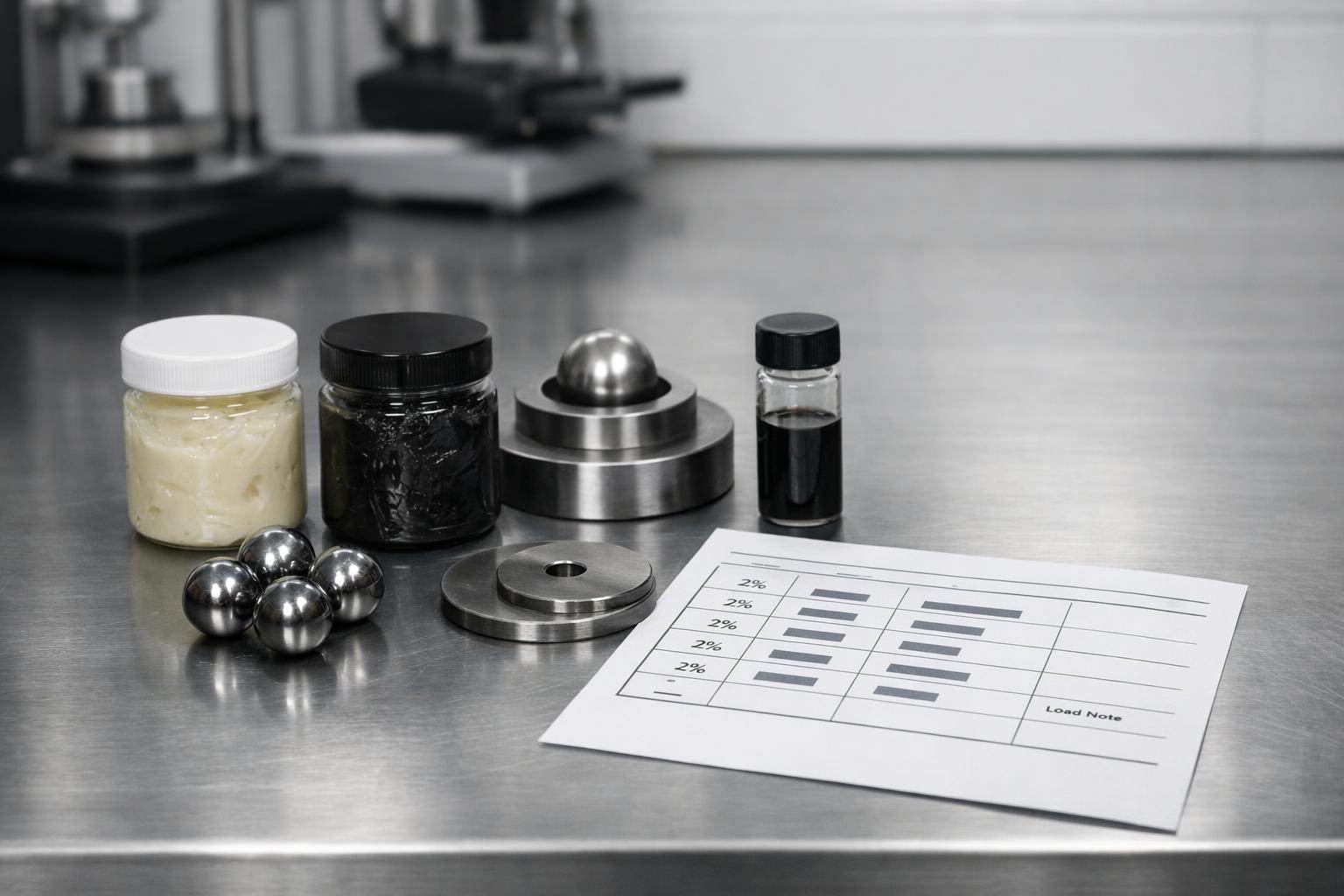
WS2 and MoS2 are measured for EP performance via the 4-ball weld point test (ASTM D2596). Typical weld point improvement with 2–3 wt% WS2: +30–60 kgf vs base grease.
Anti-Wear (AW) Additives
AW additives protect metal surfaces under normal to moderate operating loads — conditions where hydrodynamic film is present but thin, and asperity contact causes gradual wear over time. The mechanism differs from EP: rather than preventing immediate catastrophic failure, AW additives reduce the rate of progressive wear.
WS2 and MoS2 act as AW additives by depositing a persistent tribofilm on metal surfaces during initial operation. Sub-micron WS2 particles (D90 0.4 µm) are mechanically rubbed into metal surface asperities, creating a WS2 coating on the microscale that remains in place between oil changes. This tribofilm reduces wear even when the base oil film is locally disrupted.
The standard test: 4-ball wear scar diameter (ASTM D2266). Typical improvement with 2% WS2 in PAO grease: 25–40% reduction in wear scar diameter vs base grease alone.
Anti-Friction (AF) Additives
AF additives reduce the coefficient of friction (COF) — the ratio of friction force to normal force at a sliding contact. Lower COF means less energy consumption, less heat generation, less wear, and lower operating temperature. In engines and gearboxes, AF additives translate directly to measurable fuel economy improvements.
WS2 achieves COF of 0.03 in dry conditions — among the lowest values of any material. Lubricore W850 (50% WS2 in PAO-6) blended at 2–5% in final oil typically reduces COF by 15–35% vs base oil alone. EPXtra engine oil boosters (W100, W110, W310) use WS2 as the primary AF mechanism.
Standard test: High-frequency reciprocating rig (HFRR, ASTM D6079) or SRV tribometer.
Physical vs Chemical Additives: Why It Matters
| Property | Physical (WS2, MoS2, hBN) | Chemical (ZDDP, S-P types) |
|---|---|---|
| Activation mechanism | Mechanical pressure | Temperature (requires heat) |
| Yellow metal compatibility | Yes — no corrosion | No — corrodes Cu, Br, Br |
| Depletion over time | No — physical film persists | Yes — consumed by reaction |
| Low-temperature protection | Yes (works at startup) | Limited (needs warm-up) |
| Temperature range | WS2: to 650°C | Decomposes above ~200°C |
| Base oil compatibility | All base oils | Some incompatibilities |
| PFAS concerns | None | Some types have concerns |
How WS2 Works: The Physical Mechanism
WS2 particles in suspension within a lubricant are carried to the metal contact zone by the base oil. Under contact pressure, the WS2 platelet crystal is mechanically "cold-welded" to the metal surface asperities through adhesion. As sliding continues, the weak van der Waals inter-layer bonds between WS2 crystal planes shear preferentially — the layers slide over each other with extremely low resistance (COF 0.03) rather than the metal surfaces sliding against each other (COF 0.6–1.2 unlubricated steel).
This creates a self-replenishing tribofilm: fresh WS2 particles from the oil continue plating onto the contact zone as the film is slowly removed through use. See our Technology page for detailed diagrams of WS2 tribofilm formation.
FAQ
Q: Can I use WS2 instead of ZDDP?
A: WS2 provides AW and AF performance comparable to or better than ZDDP, without corrosion of yellow metals and without phosphorus content (which affects catalytic converters). For EP applications, WS2 can fully replace chemical EP additives. For some specific AW applications (camshaft, lifter) where ZDDP provides both AW and anti-oxidant benefits, a combination approach may be optimal. The EPXtra W100/W110 products are designed to supplement existing additive packages.
Q: Does particle size affect EP or AW performance differently?
A: Yes. Sub-micron WS2 (D90 0.4 µm) is superior for AW applications — smaller particles provide denser tribofilm coverage on asperities. Larger particles (1–5 µm) provide better weld-point (EP) performance because the larger platelets bridge wider asperity contacts under extreme load. Powderful Solutions' formulators can advise on optimal particle size for your specific application.
Q: How do I measure if WS2 is providing EP protection in my formulation?
A: ASTM D2596 (4-ball extreme pressure test): measures last non-seizure load (LNSL) and weld point. ASTM D2266 (4-ball wear): measures wear scar diameter. Both tests are available in Powderful Solutions' in-house tribology lab.
Powderful Solutions provides technical samples and EP/AW/AF test data. Contact our formulation team. Request samples + TDS →