








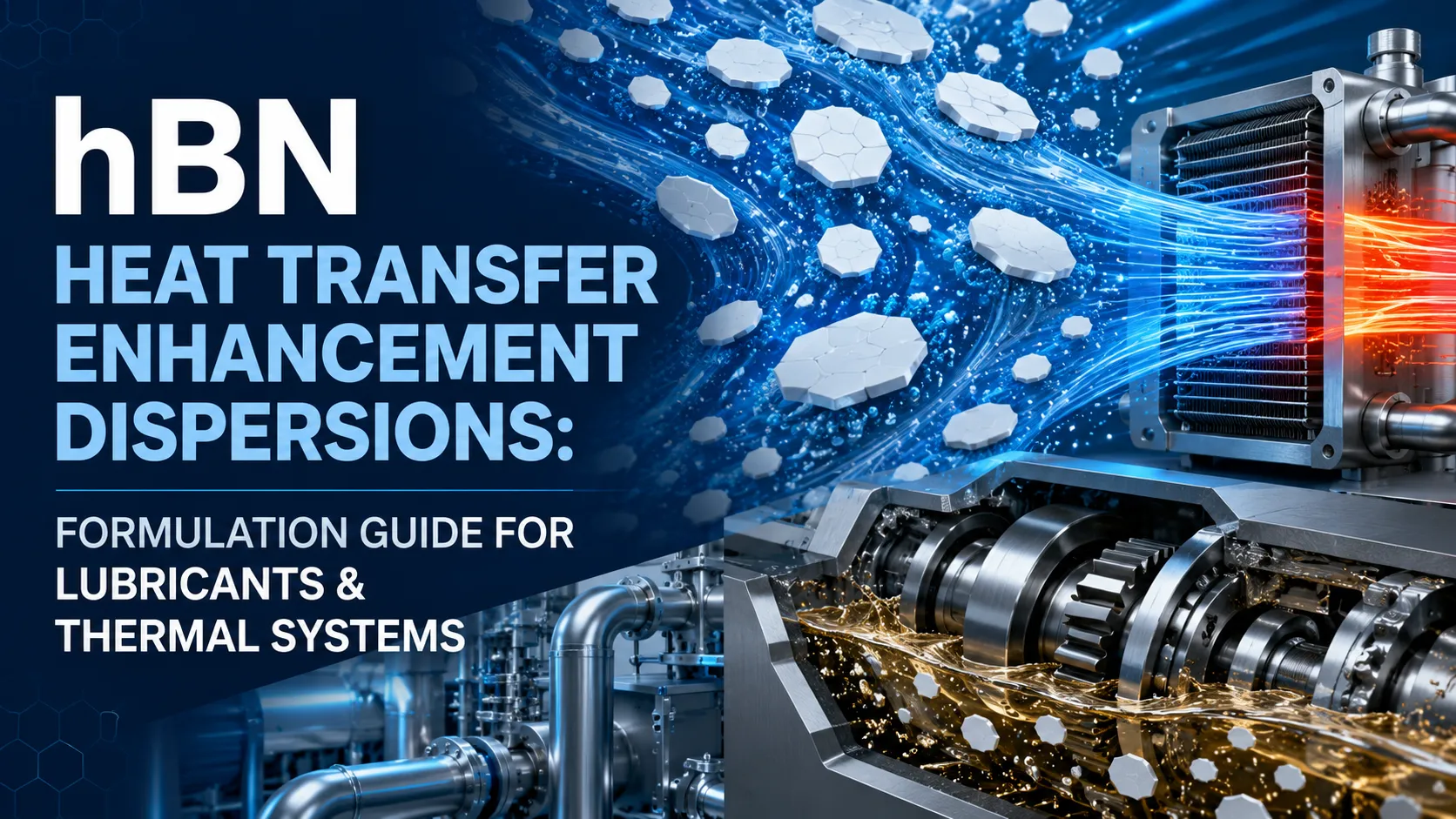
hBN Heat Transfer Enhancement Dispersions: Formulation Guide for Lubricants & Thermal Systems
Hexagonal boron nitride (hBN) is widely used in high-performance lubrication because it combines low friction, chemical stability, and thermal conductivity. For formulators, one of the highest-value use cases is hBN heat transfer enhancement dispersions — stable hBN dispersions designed to improve thermal management while maintaining lubricant performance.
This guide explains how to formulate, evaluate, and deploy hBN heat transfer enhancement dispersions in oils, greases, and thermal-lubrication systems.
Why hBN for Heat Transfer Enhancement?
Compared with many conventional solid lubricants, hBN offers a rare performance combination:
- High thermal conductivity (especially in-plane)
- Electrical insulation
- Chemical inertness
- High-temperature stability
- PTFE-free and PFAS-free profile
For applications where both tribology and thermal control matter, hBN dispersions can help reduce hot spots, improve thermal flux through the lubricant film, and stabilize operation under load.
What Is an hBN Heat Transfer Enhancement Dispersion?
An hBN heat transfer enhancement dispersion is a pre-dispersed additive concentrate where hBN particles are uniformly stabilized in a carrier fluid. Instead of dry-powder dosing, formulators use a ready-to-dose liquid system to improve:
1. Dosing consistency 2. Particle distribution in final blend 3. Storage stability 4. Manufacturing repeatability
At production scale, dispersion quality often determines whether the expected thermal benefit appears in the finished lubricant.
Key Formulation Variables
1) Particle Size Distribution
For heat-transfer enhancement in lubricating systems, particle size must balance thermal pathway formation with suspension stability.
- Submicron grades improve stability and filtration compatibility
- Larger platelets may improve thermal bridging in some systems but can raise sedimentation risk
- Target size range should be validated against pumpability and wear tests
2) Surface Treatment and Wetting
Raw hBN tends to agglomerate. Surface-modified hBN improves compatibility with base oils and synthetic fluids, reducing cluster formation and improving long-term thermal consistency.
3) Carrier Fluid Selection
Carrier fluid should be matched to the final system:
- Mineral oil systems
- PAO/ester synthetics
- Water-glycol or specialty thermal fluids (application-specific)
Mismatch between carrier polarity and final matrix is a common reason for instability.
4) Treat Rate
Typical screening windows:
- Low dose: proof-of-concept thermal response
- Mid dose: optimization for friction + heat transfer
- High dose: diminishing returns / viscosity penalty boundary
Start with stepwise loading studies and optimize against both thermal and tribological KPIs.
5) Dispersion Stability
Core stability checks:
- 24h/72h sedimentation visual + gravimetric
- Centrifuge stress testing
- Thermal aging stability
- Re-dispersion behavior
A thermally strong additive that settles quickly will underperform in real operations.
Performance Metrics to Validate
For hBN heat transfer enhancement dispersions, evaluate as a system, not a single metric.
Thermal Metrics
- Thermal conductivity delta vs baseline fluid
- Bulk temperature reduction under duty cycle
- Hot-spot suppression in loaded contact zones
- Heat-soak recovery behavior
Tribology Metrics
- Coefficient of friction (steady-state + transient)
- Anti-wear scar trend across load range
- EP response in high-load boundary regime
- Film durability over temperature ramp
Formulation & Process Metrics
- Viscosity drift at target dose
- Filterability and cleanliness compatibility
- Storage stability / shelf robustness
- Blend reproducibility batch-to-batch
Application Areas
High-intent target applications include:
- High-load grease systems with thermal rise issues
- Industrial gear and bearing lubrication under heat cycling
- Metalworking and process lubrication with localized hot zones
- Thermally stressed boundary-lubrication interfaces
- PTFE-free thermal-lubrication reformulations
Common Failure Modes (and How to Avoid Them)
Agglomeration After Blend-In
Cause: incompatible dispersant package or carrier mismatch Fix: optimize surface treatment + compatibility screening before scale-up
Thermal Gain but Viscosity Penalty
Cause: overdosing or poor particle-size targeting Fix: reduce loading, tighten PSD, validate rheology envelope
Good Lab Result, Poor Field Result
Cause: inadequate stability or real-system shear/temperature mismatch Fix: include shear-aged and thermally cycled validation in qualification protocol
Inconsistent Plant Performance
Cause: poor dosing/handling protocol Fix: standardize concentrate handling, agitation windows, and quality checks
Recommended Qualification Workflow
1. Define target use-case (thermal + friction + wear priorities) 2. Screen 2–3 hBN dispersion grades at multiple treat rates 3. Run paired thermal + tribology matrices 4. Stress-test stability (time, heat, shear) 5. Validate pilot-scale blend consistency 6. Approve production window with QC gates
This workflow reduces false positives and speeds deployment of robust formulations.
Why PTFE-Free Thermal Additives Matter
As regulatory and customer pressure increases around PFAS/PTFE, formulators are actively replacing fluorinated systems. hBN heat transfer enhancement dispersions offer a practical path for PTFE-free thermal-lubrication programs without sacrificing performance targets in many use cases.
Powderful Solutions Capability
Powderful Solutions supplies MoS2, WS2, and hBN powders and dispersions, including hBN heat transfer enhancement dispersions for demanding lubricant and thermal formulations. We support pilot and production programs with dispersion-focused application guidance.
FAQ
What is an hBN heat transfer enhancement dispersion?
A stable liquid concentrate of hexagonal boron nitride particles designed to improve thermal management and lubrication performance in formulated systems.
Is hBN electrically conductive?
No. hBN is electrically insulating, which is useful where thermal management is needed without electrical conductivity.
Can hBN dispersions replace PTFE additives?
In many formulations, hBN dispersions are used as PTFE-free/PFAS-free alternatives, but performance must be validated per application.
What should formulators optimize first?
Start with particle size, stability, and treat-rate optimization while tracking both thermal and tribological performance.
Need support on hBN heat transfer enhancement dispersions for your lubricant program? Contact Powderful Solutions for technical guidance, sample pathways, and formulation support.