



.webp)
MoS2 Grease Additive: Concentration Guide for Lubricant Formulators
MoS2 (Molybdenum Disulfide, CAS 1317-33-5) has been the standard solid lubricant additive for heavy-duty and extreme-pressure greases since the 1950s. Its proven performance record, broad OEM approval, and cost-effectiveness have made it the most widely used solid lubricant in industrial grease formulations globally — from mining to automotive to military specifications. However, choosing the wrong concentration or particle size significantly impacts both performance and economics. This guide provides precise, data-backed recommendations for MoS2 treat rates in grease formulations.
Why Use MoS2 in Grease?
MoS2 functions as a physical EP (Extreme Pressure), AW (Anti-Wear), and AF (Anti-Friction) additive through its lamellar hexagonal crystal structure. Under contact pressure, MoS2 platelets align parallel to the sliding surfaces and shear easily along the basal crystal plane, preventing metal welding under extreme loads. Unlike chemical EP additives, MoS2 does not rely on thermal activation and provides protection from the first revolution of a bearing at any temperature above approximately -185°C.
Key advantages of MoS2 in grease: immediate EP protection at startup · no temperature activation required · mechanically durable tribofilm · broad OEM and military approvals (MIL-PRF-7870, etc.) · lower cost than WS2 · black color acceptable for most industrial applications
MoS2 Concentration Guide by Application
Typical MoS2 Treat-Rate Ranges
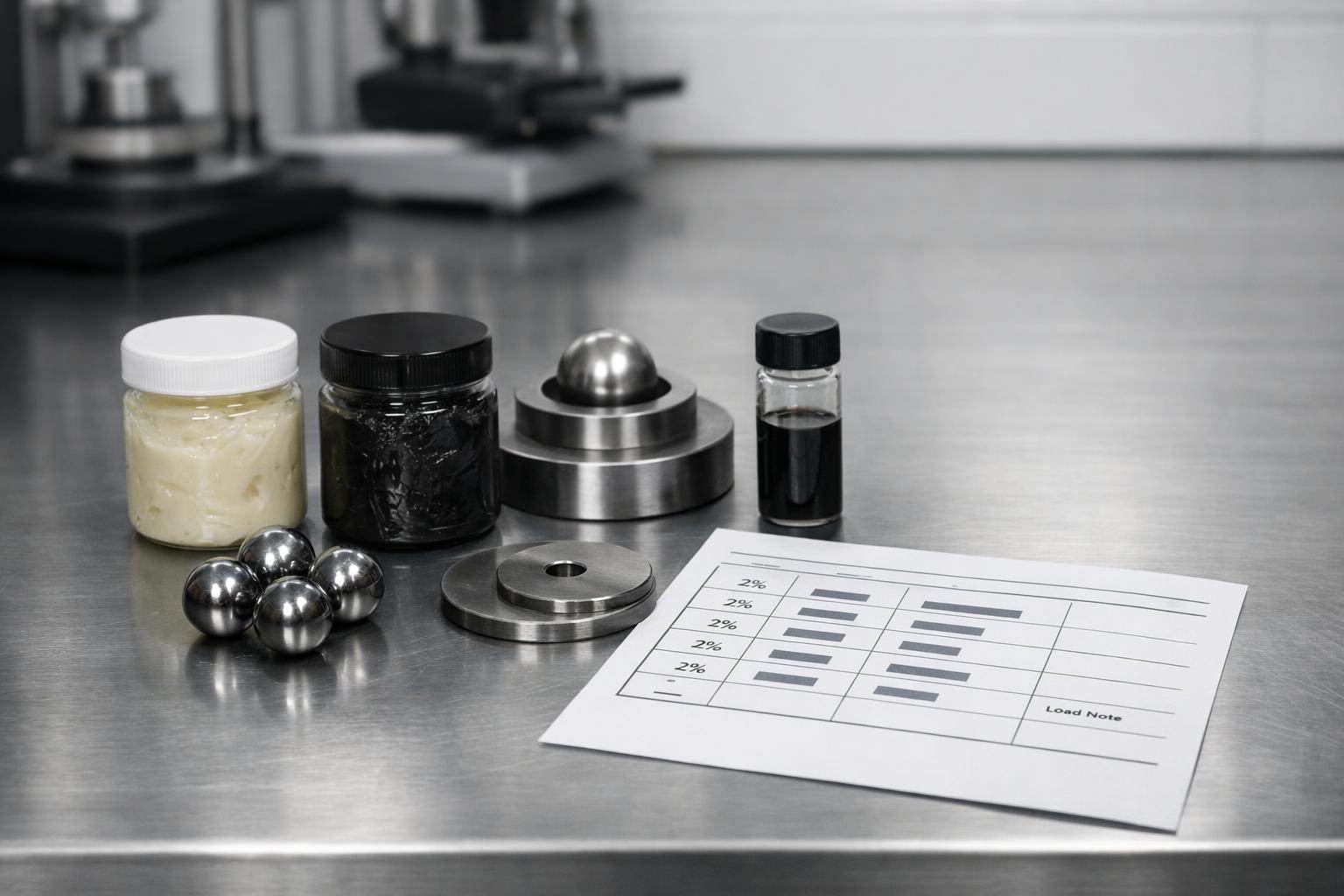
A quick visual comparison of the application ranges detailed in the formulation table below.
| Application | MoS2 wt% | Grade | Notes |
|---|---|---|---|
| General purpose greases | 1–2 wt% | D90 0.4 µm | Baseline AW + slight EP improvement |
| Standard industrial EP grease | 2–3 wt% | D90 0.4 µm | Most common — good balance of cost/performance |
| Heavy-duty EP grease (NLGI-2) | 3–5 wt% | D90 0.4 µm | Mining, construction, off-highway |
| Extreme load open gear | 3–8 wt% | D90 2.5–12.5 µm | Larger particles for rough gear surfaces |
| Military specification grease | 3–5 wt% | D90 0.4–2.5 µm | Per MIL-PRF-7870 or equivalent |
| Dry film lubricant / bonded coat | 10–30 wt% | D90 2.5–12.5 µm | Applied directly to surface |
Particle Size Selection for MoS2 in Grease
D90 0.4 µm (sub-micron) — Solidex M004: Recommended for all pump-dispensed and filter-circulated grease systems. Passes 25 µm filters without blockage. Provides maximum surface area per gram for tribofilm formation. Required for precision bearing greases and automotive applications.
D90 2.5 µm — Solidex M025: Suitable for open gear lubricants, large plain bearings, and applications where filter blockage is not a concern. Larger particles provide enhanced EP protection on rough surfaces but are not suitable for precision mechanisms or systems with fine filters.
D90 12.5 µm and coarser: Specifically for dry film coating applications and heavy-duty open gear lubricants. Not recommended for any pump-dispensed or pressurized grease system.
Incorporation Method
MoS2 powder (Solidex M004/M025) requires mechanical dispersion to prevent agglomerate formation. Recommended procedure:
Pre-Wet
Pre-wet MoS2 powder with 1–2 parts base oil by weight and mix to form a paste.
Disperse
Process through a three-roll mill or high-shear rotor-stator mixer to break down agglomerates.
Blend
Add the MoS2 paste to the base grease at 60–80°C with paddle mixer agitation.
Verify
Check fineness using a Hegman gauge and verify that no coarse particles remain at the 25 µm reading.
- Pre-wet MoS2 powder with 1–2 parts base oil by weight, mixing by hand to form a paste
- Pass through a three-roll mill (2 passes minimum) or high-shear rotor-stator mixer (Silverson L5M or equivalent, 10 min at full speed)
- Add the MoS2 paste to the base grease at 60–80°C with paddle mixer agitation (30 min)
- Verify fineness using Hegman gauge — target: no coarse particles at 25 µm reading
If a triple roll mill or high-shear mixer is not available, Powderful Solutions' Torvix M770 provides ready-to-blend MoS2 grease additive package that incorporates directly without special equipment.
MoS2 vs WS2 in Grease: When to Choose Which
| Choose MoS2 when: | Choose WS2 when: |
|---|---|
| Cost is a primary driver | Performance is the priority |
| OEM spec requires MoS2 | Lower COF is needed |
| Vacuum or inert atmosphere application | Air or ambient atmosphere operation |
| Temperature <400°C in air | Temperature >400°C in air |
| Standard industrial black grease acceptable | Color matters or PFAS-free required |
For maximum performance, WS2 + MoS2 composite (Torvix W700/W720/W730) provides the benefits of both: WS2's low friction film plus MoS2's proven EP protection at lower overall cost than all-WS2 formulation.
Testing Standards for MoS2 Grease Performance
- ASTM D2596: 4-ball extreme pressure test — measures weld point and load wear index
- ASTM D2266: 4-ball wear test — measures wear scar diameter under AW conditions
- ASTM D217: Worked penetration — verifies base grease consistency is maintained with MoS2 addition
- ASTM D2670: Falex pin-and-vee friction and wear test
- ASTM D4289: Elastomer compatibility test — verify MoS2 does not swell seals
Powderful Solutions' tribology lab performs ASTM D2596 and D2266 on customer-provided formulations for qualification testing.
FAQ
Q: Does increasing MoS2 from 3% to 5% double the EP performance?
A: No — the relationship is not linear. Weld point improvement typically plateaus above 3–4 wt% for D90 0.4 µm grades. Beyond this concentration, additional MoS2 does not proportionally increase EP protection but does increase material cost and potential for particle agglomeration. The exception is applications requiring extended drain intervals, where higher concentrations provide a reservoir of additive for the full service period.
Q: Does MoS2 react with water to form corrosive compounds?
A: Yes — in humid air above approximately 80°C, MoS2 can oxidize to form MoO3 and trace SO3/H2SO4. This is a known limitation of MoS2 versus WS2 (which is more oxidation-resistant). For greases exposed to steam, water spray, or condensing humidity at elevated temperature, WS2 is preferred. Dry lubricant storage and use in sealed grease systems minimizes this risk for standard MoS2 grades.
Q: Can I add MoS2 to a white lithium grease?
A: Technically yes — MoS2 is compatible with lithium soap thickeners. However, MoS2 will turn the grease black or dark grey, which may be unacceptable for some applications. If white color is required, use hBN instead. If color is not critical, lithium complex + MoS2 (2–3 wt%) is a standard and effective EP grease combination.
Q: What is "moly percentage" and how does it differ from wt% MoS2?
A: Some OEM specifications define MoS2 content as percentage of molybdenum (Mo) element rather than MoS2 compound. MoS2 is 60 wt% Mo by molecular weight (Mo: 96 amu, S₂: 64 amu, total: 160 amu). To convert: MoS2 wt% × 0.60 = Mo wt%. Example: 3 wt% MoS2 = 1.8 wt% Mo.
Solidex M004 (D90 0.4 µm) and Torvix M770 grease additive samples available for lab evaluation. Full TDS, SDS, and formulation support. Request samples →